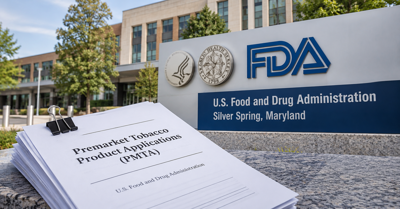
The FDA Center for Tobacco Products (CTP) at one point expected to authorize bottled e-liquids from manufacturers that submitted premarket tobacco applications (PMTAs). The FDA tobacco center’s Office of Science submitted a memo outlining a plan to speed up review of e-liquids, according to an exclusive story by Alex Norcia in Filter.
The memo, titled “Bundling and Bracketing Approach for Review of ENDS Open E-liquid PMTAs,” described a process to expedite scientific review of PMTAs for e-liquids by grouping products based on characterizing flavors, using a “flavor wheel” first published in a 2019 paper by a group of Dutch scientists. FDA scientific reviewers could have reviewed multiple products by a single manufacturer, and then bridged their conclusions to additional products included in that company’s PMTA.
The plan was intended as a time-saver for FDA scientific reviewers, but it also acknowledged the agency’s belief at the time that some bottled e-liquids would be authorized.
The memo was signed by then-Office of Science Director Matthew Holman, who recently left the FDA to work for tobacco company Philip Morris International. Filter obtained the memo from the FDA through a Freedom of Information Act (FOIA) request. (The full memo can be read in the Filter article.)
🔎👀🔍 pic.twitter.com/qikDF0n6dS
— American Vapor Manufacturers (@VaporAmerican) August 10, 2022
The planned “bundling and bracketing” system for PMTA reviews was intended to make the CTP’s job easier, but its author also said it would “increase the likelihood that more tobacco products will be reviewed and receive marketing orders before the end of the compliance period.” ("Compliance period” referred to the one-year period following the Sept. 9, 2020 PMTA submission deadline during which submitted products could be sold without the threat of FDA enforcement.)
“Essentially,” writes Norcia, “CTP seems to have imagined a couple of years ago that an expedited process would efficiently produce large numbers of marketing denials and authorizations for open-system vapes and e-liquids.” Open-system vapes are devices that can be refilled with bottled e-liquid, and the bottled e-liquid itself.
As it turns out, the FDA still hasn’t authorized a single open-system product, not even tobacco-flavored or unflavored products. Instead the agency chose to implement a review system designed to reject PMTAs for all flavored products without any review—unless manufacturers submitted expensive and time-consuming studies to prove their products provided “enough of a benefit to adult smokers that would overcome the risk posed to youth.”
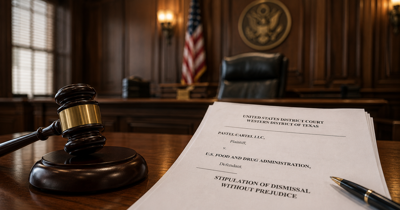
Without randomized controlled trials or longitudinal cohort studies, the agency assumed (based on scant evidence) that non-tobacco flavored products were not “appropriate for the protection of public health” and issued marketing denial orders (MDOs). The FDA denied applications for millions of products submitted by hundreds of manufacturers, and was taken to court by dozens of small companies.
Yet again, internal FDA memo surfaces outlining their shadowy process for review. Conveniently, this document appears after the appeals have been litigated. Clearly the process was rigged against small business from the beginning. What other shady secrets will be discovered? https://t.co/KoMq9fO1DM
— Amanda Wheeler (@amandawheeler32) August 10, 2022
The companies challenging the FDA in federal courts might have made good use of the “bundling and bracketing” memo—if they had seen it before their cases were decided. At the very least, it shows the CTP had envisioned authorizing some open-system products (although not necessarily flavored products), but instead someone at the FDA nixed the idea in favor of the boilerplate denial system the agency settled on.
The memo laid out a plan for CTP scientific reviewers from the Division of Product Science and Division of Nonclinical Science to randomly choose products with up to 24 characterizing flavors from a single company’s PMTA, and then to bridge the reviewers’ conclusions to other products included in the same application. The memo writer said there would be “no limit to the maximum number of tobacco products per PMTA for which the conclusions can be bridged.”
Manufacturers, of course, weren’t allowed to make assumptions about any of their own products based on information about other similar submitted products. That would have been a time- and effort-saving shortcut only granted to hard-working CTP reviewers. But the very existence of the “bundling and bracketing” memo shows the FDA recognized the foolishness of its demand that each (very similar) product be subjected to identical tests that would in all likelihood show the exact same results across a given company's product line.

CBG (cannabigerol) is the mother of all cannabinoids, including CBD and THC. Learn more about CBG flower, its effects, strains, and whether it can get you high.

Learn how old you have to be to buy caffeine pouches, including federal and state age restrictions, retailer policies, and rules for minors.
Learn whether caffeine pouches are safe, including potential side effects, caffeine limits, oral health risks, and who should avoid them.

Because of declining cigarette sales, state governments in the U.S. and countries around the world are looking to vapor products as a new source of tax revenue.