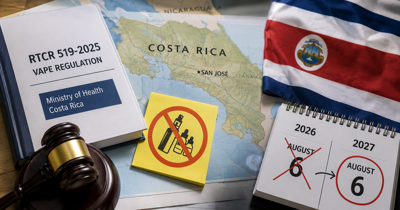
Costa Rica’s Ministry of Health has postponed enforcement of its sweeping new vape regulations until Aug. 6, 2027, giving manufacturers, importers, and retailers another year before strict flavor, packaging, and marketing rules take effect.
The delay is a reprieve, not a retreat. The ministry announced on July 7 that the change affects only the effective date of Technical Regulation RTCR 519-2025. Every product restriction and enforcement power remains intact.
Officials said they need more time to build the technical, operational, and administrative systems needed to enforce the regulation. The ministry is also acquiring an inductively coupled plasma spectrometer, laboratory equipment used to identify metals and other substances at very low concentrations.
The original rule, issued as Executive Decree 45479-S, applies to nicotine and nicotine-free e-liquid made in Costa Rica or imported into the country. It covers manufacturers, repackagers, warehouses, importers, distributors, and sellers. Products must be notified to the Health Ministry before sale, and authorities may sample them in stores and warehouses.
The regulation sets a nicotine ceiling of 20 milligrams per milliliter and limits refill containers to 10 milliliters for nicotine e-liquid and 20 milliliters for nicotine-free products. Packaging must be child-resistant, and required information must appear in Spanish. The rule also bans caffeine, taurine, most cannabinoids, several carbonyl compounds, and flavorings not included on a short permitted list.
That list contains 16 tobacco-associated flavor chemicals. The regulation separately prohibits devices, pods, or containers that emit aromas associated with fruit, desserts, spices, or other pleasant smells. It also bans packaging imagery involving food, toys, celebrities, athletes, influencers, and fictional characters.
Advertising, promotion, and sponsorship would be prohibited across retail stores, websites, apps, social media, events, and influencer campaigns. Internet or remote sales would also be barred whenever the seller cannot clearly verify that the buyer is an adult.
The regulation also survived an early legal challenge. Costa Rica’s Constitutional Chamber rejected a constitutional petition in March, leaving the government free to continue preparing for the original 2026 implementation date. The later postponement came from the executive branch, not the court.
The postponement does not leave Costa Rica without vape controls. A 2022 law already bans sales to minors and prohibits vaping in workplaces, restaurants, bars, public transportation, and many other public places. It also imposes a 20 percent tax on vaping products.
The extra year exposes an obvious problem: regulators approved a sweeping market overhaul before they had the laboratory equipment and administrative machinery to enforce it. Businesses and adult consumers get more time, but the prohibitionist endpoint is unchanged. Unless the government revises the rule, most fruit, candy, and dessert-flavored products will disappear from the legal market in August 2027.


CBG (cannabigerol) is the mother of all cannabinoids, including CBD and THC. Learn more about CBG flower, its effects, strains, and whether it can get you high.

Learn how old you have to be to buy caffeine pouches, including federal and state age restrictions, retailer policies, and rules for minors.
Learn whether caffeine pouches are safe, including potential side effects, caffeine limits, oral health risks, and who should avoid them.

Because of declining cigarette sales, state governments in the U.S. and countries around the world are looking to vapor products as a new source of tax revenue.