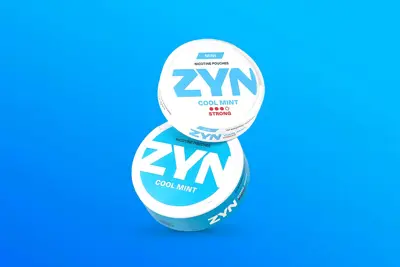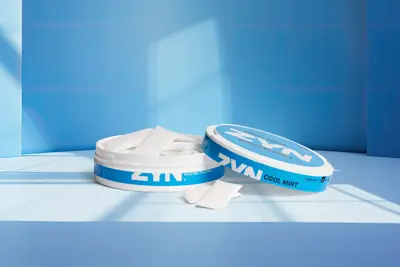
The commercial rise of ZYN over the past few years has been meteoric. Although all methods of THR (tobacco harm reduction) should be celebrated, nicotine pouches like ZYN offer unique advantages over vapes and heated tobacco products. They are simpler and more discreet, and pose no inhalation risks, which may partially explain their exponential growth.
Another explanation is their similarity to popular smokeless tobacco products, especially Swedish snus. Europeans accustomed to portion snus (contained in pouches), and Americans who use moist snuff (dip), grasp the pouch concept quickly.
So how did we get here? When did ZYN arrive on the market, and how did nicotine pouches become so popular? This article will provide an abbreviated history of smokeless tobacco products, and also explore the evolution of ZYN, where it’s from, and how it became the best-selling nicotine pouch in the world. If you’re a snus or nicotine pouch user, keep reading to learn how it all started.
The history of nicotine pouches
Nicotine pouches were invented in the early 2000s, but the story of smokeless tobacco goes back much further. A 2021 finding in Utah revealed that tobacco use by humans dates back at least 12,300 years. However, the tobacco plant was unknown outside the Americas until the 1500s, when European explorers brought the plant back with them. This was essentially when the evolution of nicotine pouches began.
Popularization of nasal snuff in France
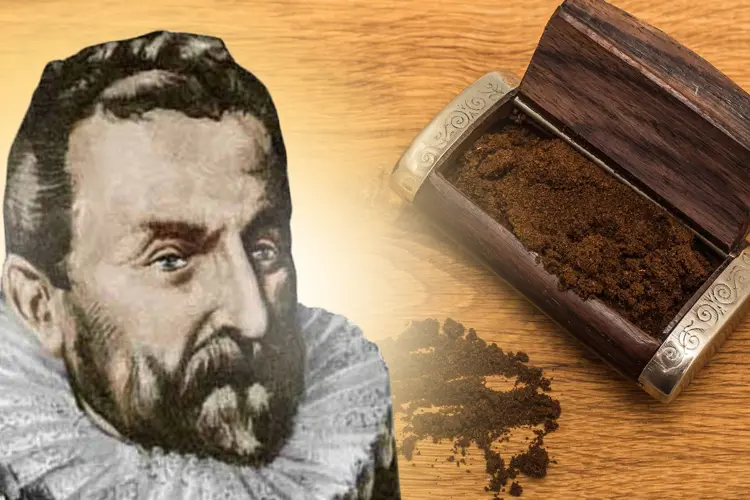
Jean Nicot, the French ambassador to Portugal, is often credited with popularizing nasal snuff in the mid-16th century. Nicot first acquired tobacco—probably imported from Florida—from friend and botanist Damião de Goes, which he proceeded to grow in his garden for experimentation.
Nicot later gifted some of his tobacco to the Queen of France, Catherine de’ Medici, as a possible remedy for her chronic migraines. He instructed her to crush the leaves and inhale nasally—the same technique used by American Indians. Not only did it alleviate the queen’s ailments, but she celebrated tobacco so loudly that it would soon be referred to as Herba Regina, or “the queen's herb.”
Thanks to the influence of royalty, nasal snuff soon became a popular trend among the French upper class, and eventually among commoners. It was considered a medicine at the time, used to treat a variety of conditions, such as headaches, colds, insect bites, wounds, vertigo, and ringworm. The active compound in tobacco was ultimately named after Nicot: nicotine—and the tobacco plant itself was given the genus Nicotiana.
Development of snus in Sweden
Nasal snuff emerged in Sweden in the 1630s, again initially popularized by the upper class. By the 1700s, Swedes were growing domestic tobacco on a large scale, which eventually led to a transition in usage. Resourceful farmers began developing a unique method of processing and consuming tobacco. They would grind it in mills, mix it with various ingredients (water, salt, potash), and ferment it in jars for up to six months. This fermented tobacco (oral snus) was enjoyed by tucking in the lip, as opposed to snorting.
In 1822, Jakob Fredrik Ljunglöf changed the tide once more by introducing pasteurization to snus manufacturing. The process was not only much faster, but it also killed potentially harmful microbes and increased the shelf-life of the product. This innovation, combined with Ljunglöf’s classic snus recipe, resulted in Ettan—the oldest snus brand, which is still on the market today.
The invention of portion snus
Another major innovation occurred 155 years later with the invention of the first portion snus. Swedish Match scientists based the idea on teabags, creating a thin pouch that allowed the flavor and nicotine to escape but kept the loose tobacco out of the user’s mouth.
In 1977 the company introduced the first commercial portion snus, called Tre Ankare. Portion snus almost immediately began to dominate the Swedish market, and laid the foundation for the development of nicotine pouches.
When were nicotine pouches invented?
The first glimpse of the nicotine pouches that we know today arrived a few decades later. They were developed by a Swedish company called Niconovum—led by celebrated nicotine and smoking cessation expert Karl Olov Fagerström—in the early 21st century. Their 2 mg pouches were registered as a nicotine replacement therapy (NRT) product in 2008 under the brand name Zonnic.
Snus manufacturers soon realized the potential of nicotine pouches as a consumer product, and began developing their own pouches. One of these companies was Swedish Match, and its nicotine pouch was called ZYN.
The history of ZYN
Where was ZYN invented?
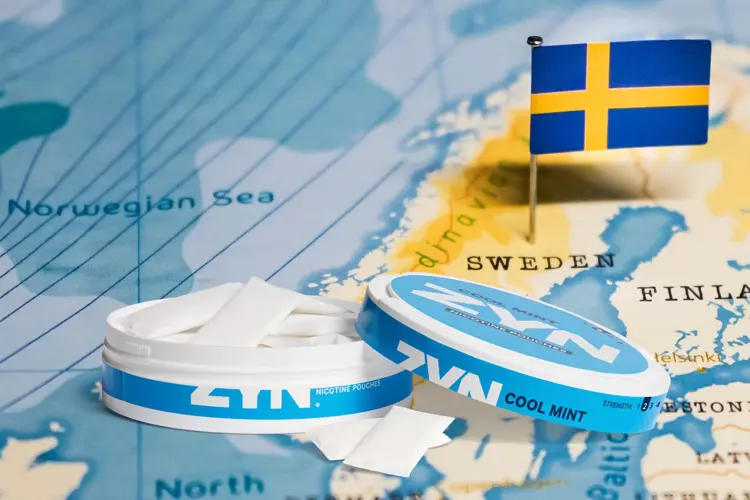
ZYN was invented by Swedish Match, Scandinavia’s largest snus manufacturer. The product was developed by biochemists Mattias Sharpe-Sjöberg and Linus Mealey in the early 2010s.
When did ZYN come out?
ZYN was first test-marketed in the U.S. in 2014. In 2016, Swedish Match dramatically expanded its commercial reach, making ZYN available in over 4,000 stores in the western U.S. The increased exposure and availability led to exponential growth over the next few years.
Swedish Match shipped about one million containers in the first quarter of 2017. That number skyrocketed to over 131 million in the first quarter of 2024. ZYN currently owns over 70 percent the the U.S. nicotine pouch market.
Unless halted by tighter regulations across the globe, ZYN’s staggering annual growth seems unlikely to slow down any time soon.
Where are ZYN products made?
ZYNs were originally manufactured only in Sweden, but U.S. ZYN products are now produced at Swedish Match’s Owensboro, Kentucky plant. The expansion included building a $115 million, 16,000-square-foot production facility and creating 120 new jobs. In July 2024, the company announced it will construct a second U.S. ZYN manufacturing facility in Aurora, Colorado.
Who owns ZYN now?
In late 2022, Philip Morris International (PMI) acquired ownership of ZYN manufacturer Swedish Match. This occurred just 21 months after the acquisition of AG Snus, makers of the Shiro brand, which was PMI’s first foray into nicotine pouches. Both acquisitions embraced PMI’s objective to prioritize smoke-free products and move away from combustible tobacco. PMI discontinued Shiro nicotine pouches in 2023, opting to dedicate its focus and resources to the more popular ZYN brand.


China destroyed more than 55,000 vapes and 188 million smuggled cigarettes as a wider crackdown seized $355 million in illicit tobacco.

Eight EU governments want a ban on new nicotine products, broad flavor restrictions, and tighter rules for vapes and nicotine pouches.

UK expands age-18 rules to nicotine-free vapes and nicotine pouches on Oct. 29, banning vending machines, promotional giveaways, and major discounts.

UK smoking falls to a record-low 9.8% in 2025, while 5.4 million adults vape in Great Britain, according to new government statistics.

Check out our OXVA XLIM 4 and XLIM PRO 4 review to learn about the new UNITECH 3.0 pods and the incredibly innovative anti-burn tech (ABT).
The DOJO BLAST X combines a 10 mL refill system, a dual-mesh coil, and a 1000 mAh battery. Is it needlessly confusing? Read our review to find out.
The Lost Mary BM6000 is a pre-filled pod vape that pairs a 2 mL pod with a 10 mL refill container and a QUAQ mesh coil. Read our review to learn more.
The DOJO PUREX 60K is a disposable vape with a 1000 mAh battery, 16 mL INSTA-JUICED tank, and two power modes. Read our review to learn more.